Information Disclosure Based on TCFD Recommendations
The Group recognizes that responding to climate change is an important management issue and attaches great importance to strategy and flexibility in dealing with uncertain situation changes.
In accordance with the Group’s policy on climate change, we will aim at enhancing the corporate value through continuous consideration and information disclosure of the four items recommended by TCFD, and constructive dialog with various stakeholders.
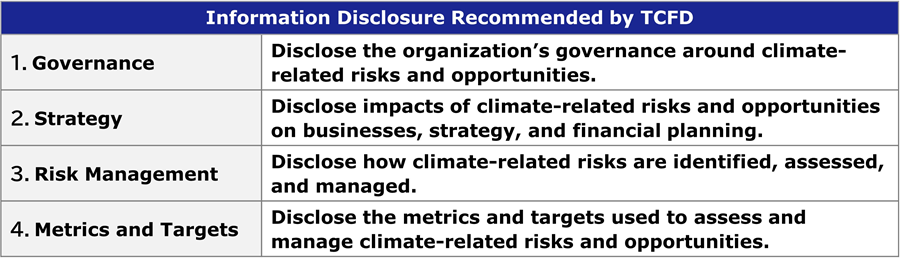
- (※1)Task Force on Climate-Related Financial Disclosures: A task force established by the Financial Stability Board in order to reduce the risk of instability in financial markets related to climate change.
The task force has presented a framework for companies who are voluntarily disclosing information on the climate-related risks and opportunities.
In April 2021, the Group joined the Task Force on Climate related Financial Disclosures (TCFD) Recommendation(※1).In addition,we conducted a scenario analysis for the data center business, which accounts for 80% of the Group's greenhouse gas emissions and is considered to have a significant impact on climate change.
In FY2023, we broadened the scope of the scenario analysis to include all businesses to determine the impact of climate change on the entire the Group, and reviewed the selected scenarios.
Worldview, Risks and Opportunities in Each Scenario
Worldviews for a 1.5 °C scenario and a 4 °C scenario were defined based on the external scenarios from the International Energy Agency (IEA) and the Intergovernmental Panel on Climate Change (IPCC). We have identified risks and opportunities linked to climate change by referencing various government reports and disclosure standards such as SASB and IFRS S2.
<1.5 °C scenario>
We have assumed a society where bold policies and technologies are implemented to limit the temperature rise to 1.5 °C or less above the pre-industrial level at the end of the 21st century, mainly based on the Net Zero Emissions by 2050 Scenario (NZE) and Announced Pledges Scenario (APS) used in the IEA's World Energy Outlook (WEO) 2023.
<4 °C scenario>
We have assumed a society where the temperature will rise more than 4 °C above pre-industrial levels by the end of the 21st century due to continuous reliance on fossil fuels and increasing greenhouse gas emissions, mainly based on the RCP8.5 scenario and the SSP5-8.5 scenario in the IPCC's 5th and 6th Assessment Reports.
For more information about specific risks and opportunities, please see “Impact of Risks and Opportunities.”
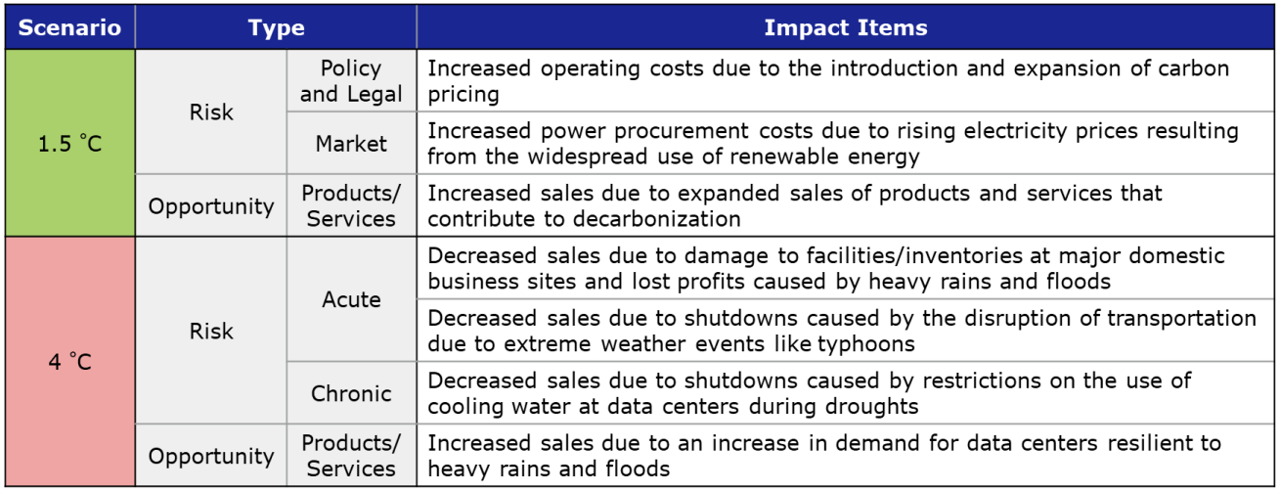
Impact Assessment
<1.5 °C scenario>
We have evaluated the risk of an increase in operating costs due to the introduction and expansion of carbon pricing. The evaluation is based on the assumption that we will implement measures to reduce greenhouse gas emissions to reach the Group’s targets of reducing Scope 1 and Scope 2 emissions (a 47% reduction from FY2019 by FY2030 and a 100% reduction by 2050). As a result, it is also assumed that the negative impact of carbon pricing will be reduced. We have also evaluated the possible increase in power procurement costs attributed to the rising price of electricity primarily driven by the greater utilization of decarbonized energy sources. We have evaluated opportunities to increase sales by leveraging the increasing demand for carbon-free data centers, which is driven by society’s increasing commitment to the reduction of greenhouse gas emissions, and the rising need for new services aligned with the changes in the social environment.
<4 °C scenario>
We have evaluated the risks of flooding and drought due to climate change at our major domestic offices. We used Aqueduct, a tool provided by the World Resources Institute (WRI), to confirm that there are no flood or drought risks at each office. We have concluded that these risks do not have the potential to financially impact us. Enabling our employees to work remotely, the Group is not at risk of being financially affected by transportation disruptions caused by extreme weather events such as typhoons. We have evaluated an opportunity to increase sales through data centers that are resilient to natural disasters as extreme weather events are on the rise due to climate change.
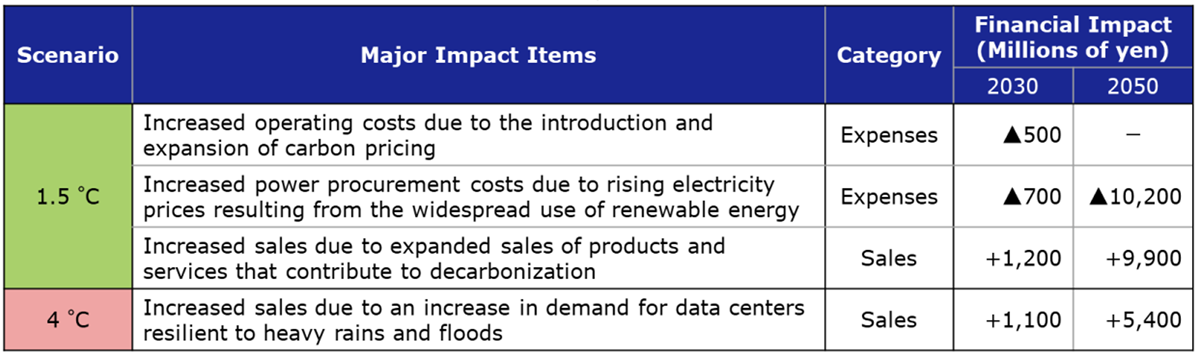
Actions Related to Risks and Opportunities of Climate Change
We identified risks and opportunities in each scenario, and considered policy directions as well as perspectives of countermeasures. In future, we will continue consideration of measures to avoid or mitigate risks and to seize opportunities; we will also aim at enhancing resilience of business activities through implementation of designed measures.
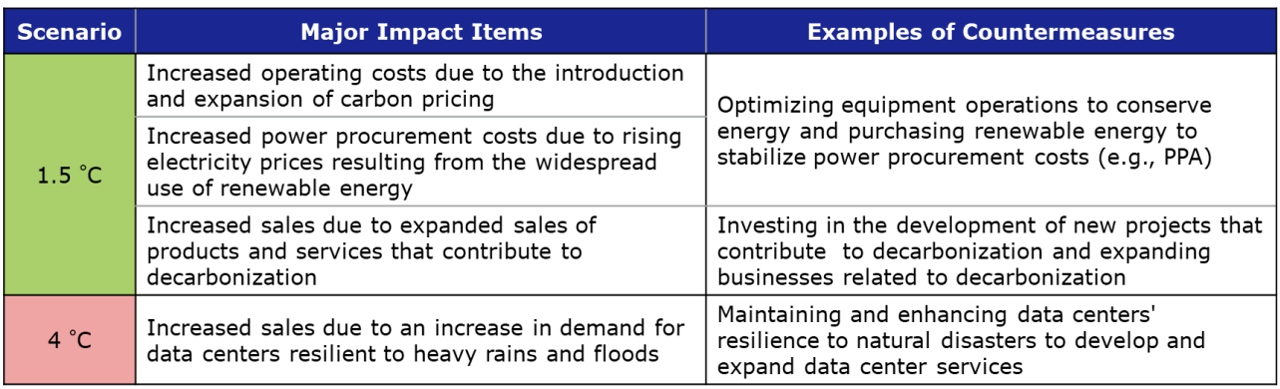
For more details, please see the Information Disclosure Based on TCFD Recommendations.
